

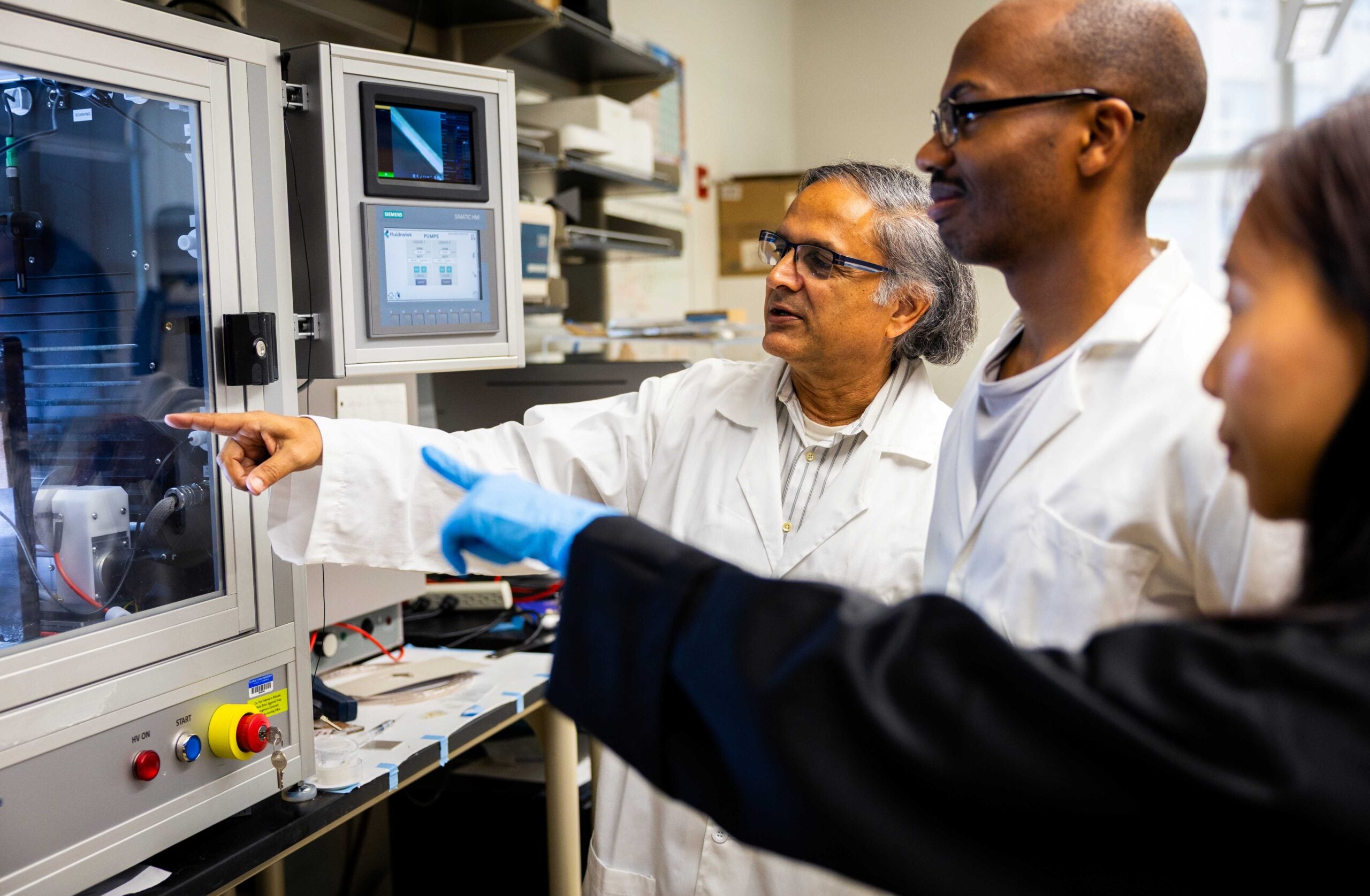
NSF Award Unites Science and Business Expertise to Accelerate Georgetown Discoveries Into Real-World Solutions
Georgetown University has gained momentum in translating research into marketplace innovations with a new award from the National Science Foundation, accelerating technologies that improve health, strengthen economic competitiveness, enhance national security, and address urgent societal challenges.
Starting in October, with Duke University, which will serve as a mentor organization, Georgetown will build industry partnerships focused on use-inspired research, with specific programs and events in workforce development. The initiative will also draw on Duke’s significant expertise in digital and data innovations, as well as social innovation.
Tatiana Litvin-Vechnyak, PhD, Georgetown’s vice president for technology commercialization, is principal investigator on the award. Co-principal investigators are the university’s vice provost for research, Jeffrey Urbach, PhD, and Sandeep Dahiya, PhD, Crnkovich Family Business of Health Chair and director of the Business of Health Initiative at the McDonough School of Business.
“This award is built on years of dedication from our faculty and research colleagues who have worked tirelessly to lay the groundwork for a thriving translational ecosystem,” said Litvin-Vechnyak, who leads Georgetown’s Office of Technology Commercialization . “We are deeply grateful to the National Science Foundation for this award and to the visionary university leaders who have built a foundation for success here at Georgetown.”
Arthur Lupia, who previously led research at the University of Michigan, and is now Georgetown’s senior vice president and chief research officer, added, “With this award, we can provide essential accelerants for researchers in fields that have great potential for commercialization. This work drives economic growth, benefits society and reflects Georgetown’s positive momentum.”
Breakthroughs often stall before reaching the public because researchers lack access to the industry networks, market insights, translational expertise, and validation resources needed to advance discoveries into adoption and use. And while life science discoveries have more established pathways to commercialization, other disciplines don’t always have the same support for development. As part of the new initiative, Seed Translational Research Projects will advance cutting-edge discoveries in the physical sciences, software, artificial intelligence, data science, and other digital innovations.
“Georgetown has the opportunity to increase our impact by strengthening our translational capacity and culture in the physical and computer sciences,” Urbach said. “Thanks to the NSF’s support, we can build this capacity institution-wide while extending the great work that the OTC team has achieved across campus.”
Researchers leading initial Seed Translational Research Projects include:
- Kai Liu, PhD, professor of physics, prototyping nanoporous metal foams for use as smart masks and air filters
- Makarand Paranjape, PhD, associate professor of physics, engineering a noninvasive transdermal patch for delivering macromolecular and hydrophilic drugs
- Lisa Singh, PhD, professor of computer science, translating multimodal AI technologies into a platform that assesses the authenticity and integrity of digital media against generative AI manipulation
- J.C. Smart, PhD, professor of computer science, leveraging two existing computational platforms, ATra and AvesTerra, to build a scalable, data-driven system to help transform research translation into a more systematic and reproducible process
A distinctive aspect of the award is its cross-disciplinary reach beyond the sciences through Georgetown’s McDonough School of Business.
“Launching discoveries into real-world applications requires business acumen and an appreciation of market forces,” said co-principal investigator Dahiya. “At the McDonough School of Business, we’re excited to partner with our colleagues on the science side of the university and to bring our students together for collaborative training experiences that will be rewarding both intellectually and in terms of real impact.”
The four-year, $6 million project, GROW: Georgetown Research & Innovation Translation (GRIT 2.0) , is one of several awarded by the NSF this year as part of the Accelerating Research Translation (ART) program.
Led by the NSF Directorate for Technology, Innovation and Partnerships (TIP), the ART program seeks to advance the US scientific and economic leadership by building capacity and increasing the number of robust translational research ecosystems in institutions of higher education that span across the full geography of the nation.
The Georgetown team will draw on the experience of collaborators at mentor institution Duke University – particularly the significant software and digital innovation expertise of Daniel Dardani, director of physical sciences and digital innovation licensing and corporate alliances with Duke’s Office for Translation & Commercialization and Office for External Partnerships.
“There is a lot of value in institutions learning from one another, especially in an area like AI, data, and digital health innovation where the technologies and commercialization models continue to evolve quickly,” Dardani said. “Duke has built considerable experience in this space, and we’re looking forward to the opportunity to share the best practices we’re pioneering at Duke with our colleagues at Georgetown, while developing shared playbooks that can benefit researchers and innovators well beyond our two institutions.”